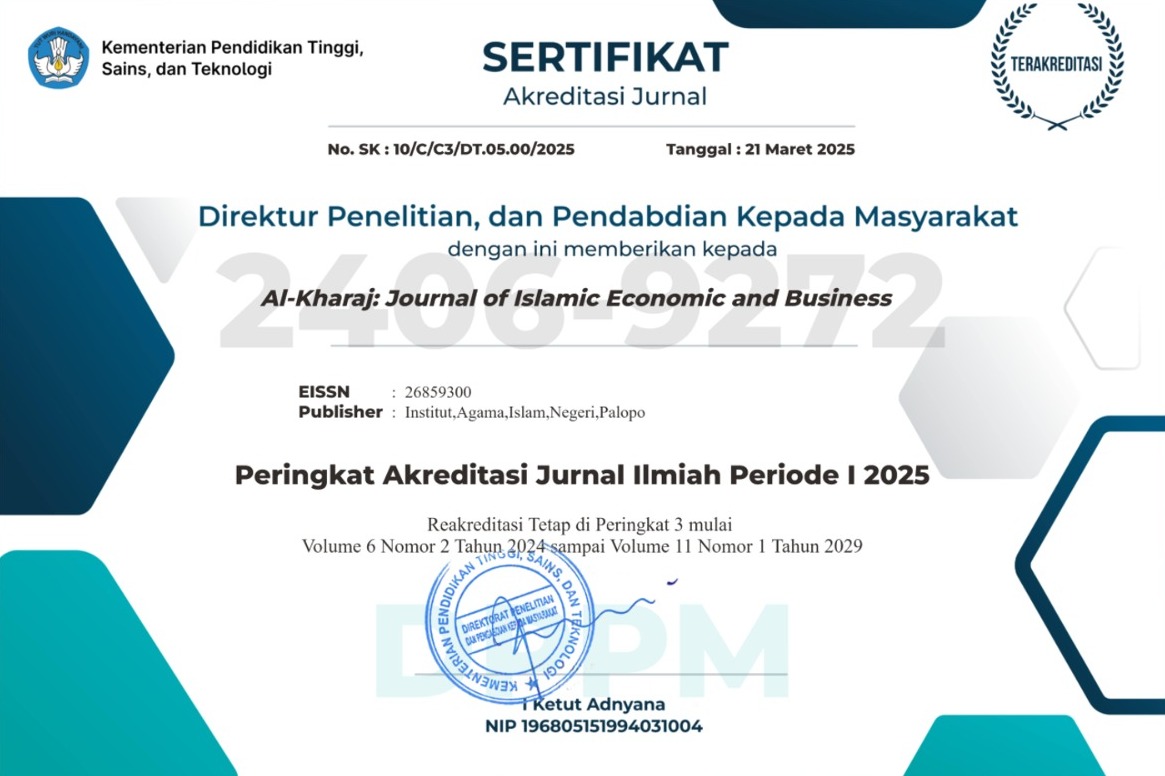
E-Service Quality and E-Loyalty in Online Travel Platforms: Evidence from East Indonesian Users
DOI:
https://doi.org/10.24256/kharaj.v8i2.9894Keywords:
e-service quality, e-loyalty, online travel platform, Traveloka, digital service qualityAbstract
This study wants to find out how electronic service quality (e-servqual) affects electronic loyalty (e-loyalty) among Traveloka users in Kendari City, Indonesia. The study looks at how the quality of digital services offered by an online travel platform affects users' loyalty, especially their plans to use the site again and tell others about it. While prior research has extensively examined the correlation between service quality and client loyalty in e-commerce, empirical investigations concentrating on online travel platforms in emerging nations are still somewhat scarce. Specifically, research examining the influence of electronic service quality on user loyalty within online travel agents (OTAs) in Eastern Indonesia remains limited. This study adds to the body of research by looking at how the quality of e-services affects e-loyalty in the digital travel service environment. Methods: This study used a survey method and a quantitative explanatory approach. We got information from 100 people who had used the Traveloka app in Kendari City. We employed purposive sampling to get the data, and we used structured questionnaires to do so. We used SPSS software to look at the association between e-service quality and e-loyalty by using descriptive statistics and simple linear regression. Results: The findings demonstrate that e-service quality exerts a favorable and significant influence on e-loyalty among Traveloka users. This shows that customers are more likely to stick with the platform if it has better service, a more reliable system, is easier to use, and is safer for transactions. What it means: The results show how important it is to improve the quality of electronic services in order to keep customers coming back in the competitive online travel company operations. Implications: The results highlight the importance of improving electronic service quality in order to strengthen customer loyalty in the competitive online travel industry. Practically, the findings suggest that online travel platforms should continuously enhance system performance, usability, and security features to maintain long-term user engagement and loyalty.
References
Anderson, R. E., & Srinivasan, S. S. (2003). E-satisfaction and e-loyalty: A contingency framework.
Blut, M. (2016). E-service quality: Development of a hierarchical model. Journal of Retailing, 92(4), 500–517. https://doi.org/10.1016/j.jretai.2016.09.002
Blut, M., Chowdhry, N., Mittal, V., & Brock, C. (2015). E-service quality: A meta-analytic review. Journal of Retailing, 91(4), 679–700. https://doi.org/10.1016/j.jretai.2015.05.004
Collier, J. E., & Bienstock, C. C. (2006). Measuring service quality in e-retailing. Journal of Service Research, 8(3), 260–275. https://doi.org/10.1177/1094670505278867
Cyr, D. (2008). Modeling website design across cultures: Relationships to trust, satisfaction, and e-loyalty. Journal of Management Information Systems, 24(4), 47–72. https://doi.org/10.2753/MIS0742-1222240402
Gefen, D., Karahanna, E., & Straub, D. W. (2003). Trust and TAM in online shopping: An integrated model. MIS Quarterly, 27(1), 51–90.
Harris, L. C., & Goode, M. M. H. (2004). The four levels of loyalty and the pivotal role of trust. Journal of Retailing, 80(2), 139–158. https://doi.org/10.1016/j.jretai.2004.04.002
Kim, D. J., Ferrin, D. L., & Rao, H. R. (2009). Trust and satisfaction, two stepping stones for successful e-commerce relationships: A longitudinal exploration. Information Systems Research, 20(2), 237–257. https://doi.org/10.1287/isre.1080.0188
Kim, J., Jin, B., & Swinney, J. (2009). The role of e-tail quality, e-satisfaction and e-trust in online loyalty development process. Journal of Retailing and Consumer Services, 16(4), 239–247. https://doi.org/10.1016/j.jretconser.2008.11.019
Oliver, R. L. (1999). Whence consumer loyalty? Journal of Marketing, 63(4), 33–44. https://doi.org/10.1177/00222429990634s105
Parasuraman, A., Zeithaml, V. A., & Malhotra, A. (2005). E-S-QUAL: A multiple-item scale for assessing electronic service quality. Journal of Service Research, 7(3), 213–233. https://doi.org/10.1177/1094670504271156
Ribbink, D., Van Riel, A. C. R., Liljander, V., & Streukens, S. (2004). Comfort your online customer: Quality, trust and loyalty on the internet. Managing Service Quality, 14(6), 446–456. https://doi.org/10.1108/09604520410569784
Santos, J. (2003). E-service quality: A model of virtual service quality dimensions. Managing Service Quality, 13(3), 233–246. https://doi.org/10.1108/09604520310476490
Zeithaml, V. A., Parasuraman, A., & Malhotra, A. (2002). Service quality delivery through websites: A critical review of extant knowledge. Journal of the Academy of Marketing Science, 30(4), 362–375. https://doi.org/10.1177/009207002236911
Downloads
Published
How to Cite
Issue
Section
Citation Check
License
Copyright (c) 2026 Muhammad Suriyadarman Rianse, Muhammad Fajar Salemaku, Najarudin

This work is licensed under a Creative Commons Attribution-ShareAlike 4.0 International License.
Authors retain copyright and grant the journal right of first publication with the work simultaneously licensed under a Creative Commons Attribution-ShareAlike 4.0 International License. In line with the license, authors are allowed to share and adapt the material. In addition, the material must be given appropriate credit, provided with a link to the license, and indicated if changes were made. If authors remix, transform or build upon the material, authors must distribute their contributions under the same license as the original.