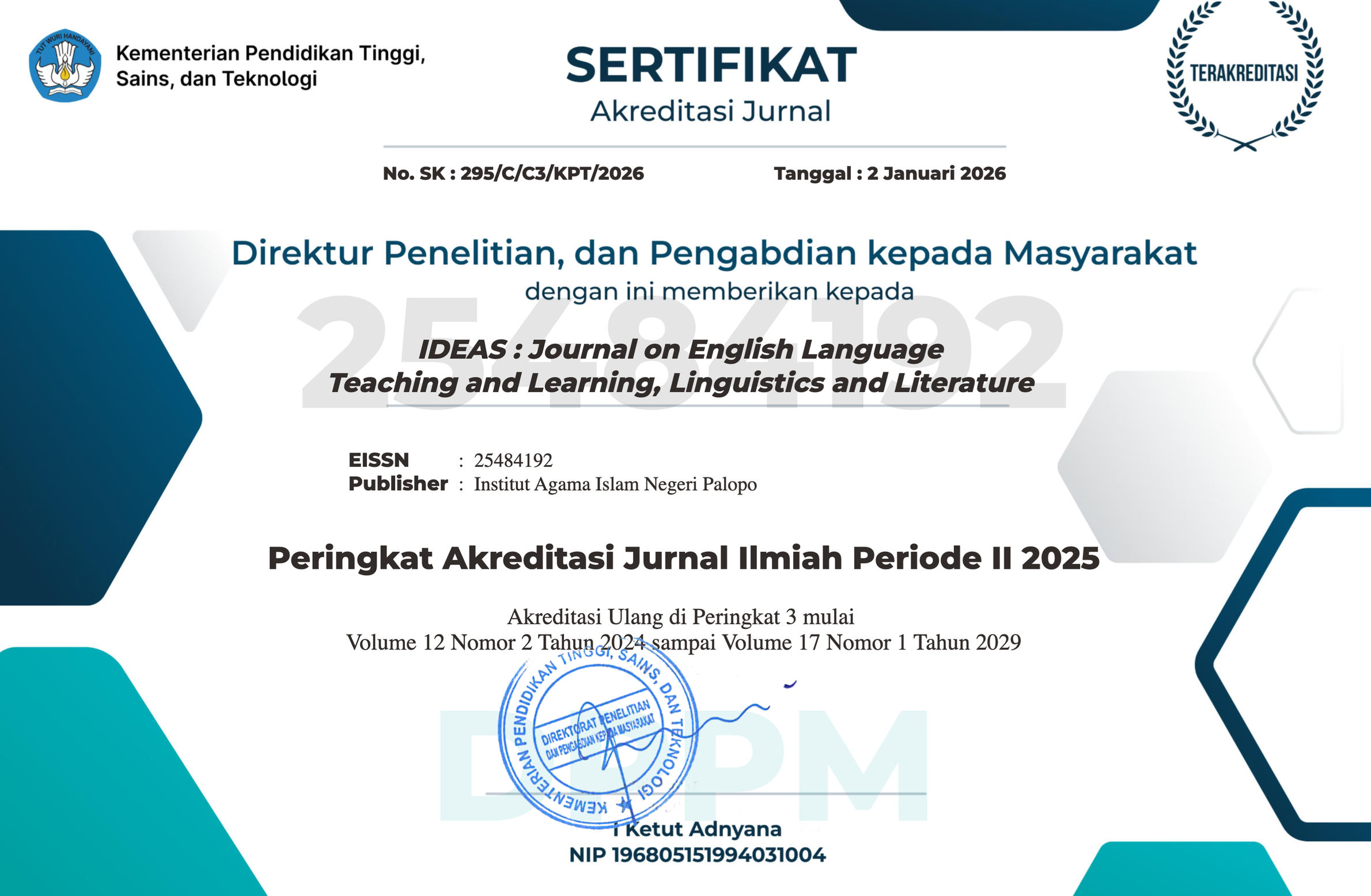
Principal Leadership and History Teacher Performance at Vocation High School
DOI:
https://doi.org/10.24256/ideas.v14i2.13112Keywords:
academic supervision; history teaching; principal leadership; teacher performance; vocational educationAbstract
School leadership can support teachers through professional learning, instructional supervision, and the organization of everyday teaching responsibilities. This study examined principal leadership, efforts to develop history teacher performance, and the forms of support associated with teaching at SMK DDI Siendeng, Central Sulawesi, Indonesia. A qualitative design combined a phenomenological perspective with descriptive reporting. Five informants were selected purposively: the principal, the vice principal for curriculum, a history teacher, a general teacher, and a grade XI student. Data were collected through semistructured interviews, nonparticipant observation, and documentation, then analyzed through data collection, reduction, display, and conclusion verification. Triangulation compared participant accounts with classroom observations and documents. Findings identified support for training and subject teacher forums, shared planning, examination of teaching documents, classroom supervision, feedback, and reminders about professional responsibilities. The history teacher described preparing teaching modules, combining explanation with discussion and questioning, assessing students through several activities, and providing additional guidance or enrichment. However, one teacher reported that management coordination was concentrated at the beginning of the semester and needed strengthening afterward. An appended teaching module indicated planned opportunities for historical inquiry, although planning documents did not establish their implementation. Leadership therefore appeared to support the conditions under which teaching was organized, rather than demonstrate a measured improvement in performance or achievement. The study recommends continuous coordination, documented supervision follow-up, and professional learning connected to historical content and students' work. Further research should examine these practices over time and assess teaching through evidence of classroom practice as well as administrative readiness.
References
Gazali, H., Ridho, M., & Gistituati, N. (2023). Pengaruh kepemimpinan kepala sekolah terhadap kinerja guru di SMK Negeri 1 Singkarak [The influence of principal leadership on teacher performance at SMK Negeri 1 Singkarak]. Journal of Education Research, 4(3), 1193–1201. https://doi.org/10.37985/jer.v4i3.354
Gore, J., Lloyd, A., Smith, M., Bowe, J., Ellis, H., & Lubans, D. (2017). Effects of professional development on the quality of teaching: Results from a randomised controlled trial of Quality Teaching Rounds. Teaching and Teacher Education, 68, 99–113. https://doi.org/10.1016/j.tate.2017.08.007
Hallinger, P. (2018). Bringing context out of the shadows of leadership. Educational Management Administration & Leadership, 46(1), 5–24. https://doi.org/10.1177/1741143216670652
Harsono, & Prasetyo, I. (2021). Kompetensi komunikasi kepala sekolah dalam meningkatkan kinerja guru SMK Kartika V-I Balikpapan [Principal communication competence in improving teacher performance at SMK Kartika V-I Balikpapan]. Jurnal Manajerial Bisnis, 4(3), 174–189. https://doi.org/10.37504/jmb.v4i3.323
Huijgen, T., van de Grift, W., van Boxtel, C., & Holthuis, P. (2017). Teaching historical contextualization: The construction of a reliable observation instrument. European Journal of Psychology of Education, 32(2), 159–181. https://doi.org/10.1007/s10212-016-0295-8
Kraft, M. A., Blazar, D., & Hogan, D. (2018). The effect of teacher coaching on instruction and achievement: A meta-analysis of the causal evidence. Review of Educational Research, 88(4), 547–588. https://doi.org/10.3102/0034654318759268
Leithwood, K., Harris, A., & Hopkins, D. (2020). Seven strong claims about successful school leadership revisited. School Leadership & Management, 40(1), 5–22. https://doi.org/10.1080/13632434.2019.1596077
Liebowitz, D. D., & Porter, L. (2019). The effect of principal behaviors on student, teacher, and school outcomes: A systematic review and meta-analysis of the empirical literature. Review of Educational Research, 89(5), 785–827. https://doi.org/10.3102/0034654319866133
Miles, M. B., & Huberman, A. M. (1994). Qualitative data analysis: An expanded sourcebook (2nd ed.). Thousand Oaks, CA: Sage.
Muharram, M., Purnamawati, Abdul Djawad, Y., Darmawang, & Arfandi, A. (2024). Kepemimpinan kepala sekolah dalam meningkatkan kinerja guru di Sekolah Menengah Kejuruan Negeri Palopo [Principal leadership in improving teacher performance in state vocational schools in Palopo]. Didaktika: Jurnal Kependidikan, 13(2), 1541–1550. https://doi.org/10.58230/27454312.744
Mulyasa, E. (2022). Manajemen dan kepemimpinan kepala sekolah [School principal management and leadership]. Jakarta, Indonesia: Bumi Aksara.
Sims, S., & Fletcher-Wood, H. (2021). Identifying the characteristics of effective teacher professional development: A critical review. School Effectiveness and School Improvement, 32(1), 47–63. https://doi.org/10.1080/09243453.2020.1772841
Downloads
Published
Issue
Section
Citation Check
License
Copyright (c) 2026 Moh. Fajri, Idrus, Hasan

This work is licensed under a Creative Commons Attribution-ShareAlike 4.0 International License.
Authors retain copyright and grant the journal right of first publication with the work simultaneously licensed under an Attribution-ShareAlike 4.0 International (CC BY-SA 4.0) that allows others to share the work with an acknowledgement of the work's authorship and initial publication in this journal.
Authors are able to enter into separate, additional contractual arrangements for the non-exclusive distribution of the journal's published version of the work (e.g., post it to an institutional repository or publish it in a book), with an acknowledgement of its initial publication in this journal.
Authors are permitted and encouraged to post their work online (e.g., in institutional repositories or on their website) prior to and during the submission process, as it can lead to productive exchanges, as well as earlier and greater citation of published work (See the Effect of Open Access)