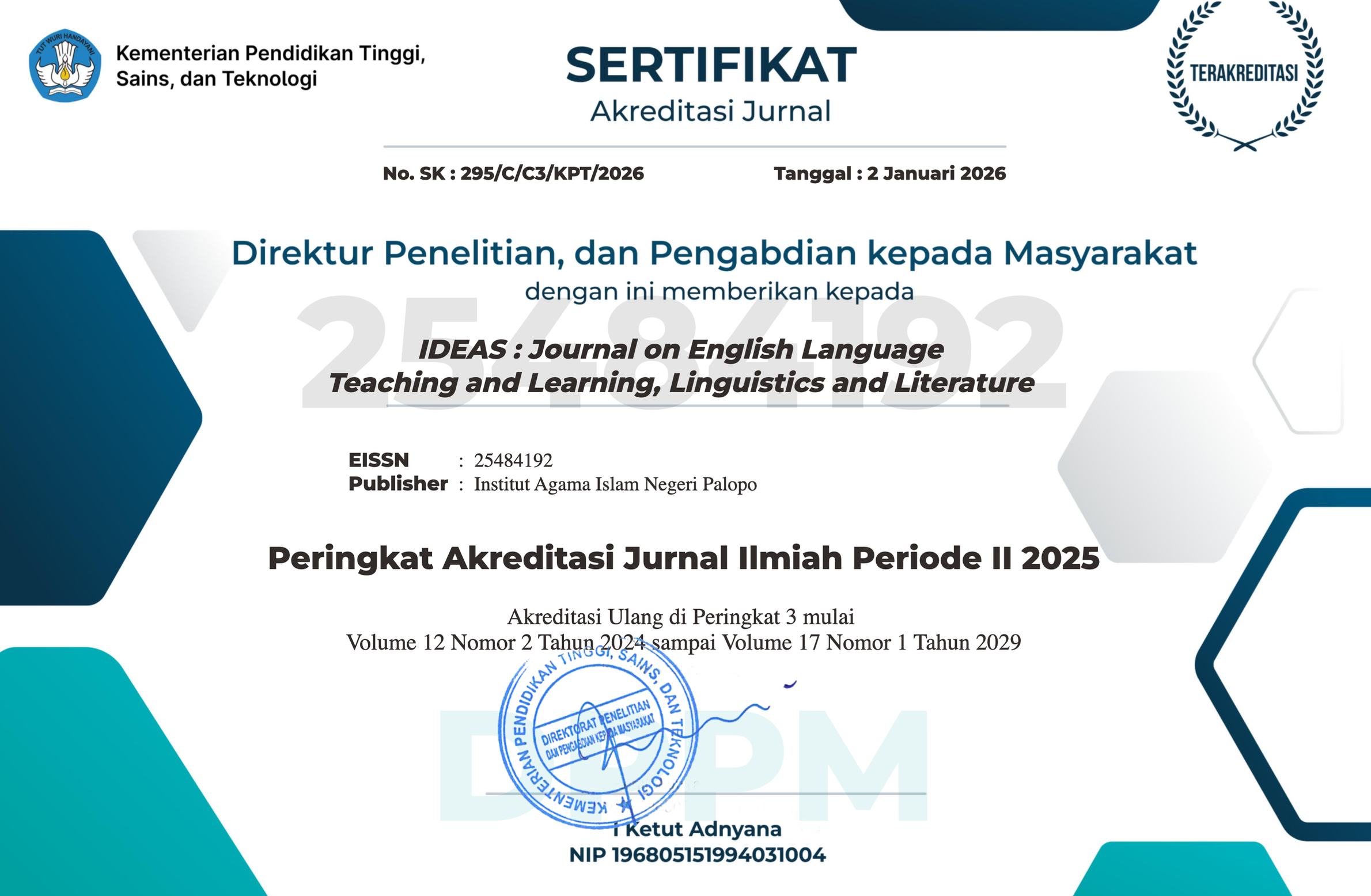
EFL Pre-Service Teacher Anxiety During Kampus Mengajar Program at Junior High School
DOI:
https://doi.org/10.24256/ideas.v13i2.5119Keywords:
EFL Teacher, Kampus Mengajar, Pre-Service Teacher, Teaching AnxietyAbstract
This study aimed to identify the causes of pre-service teacher anxiety during the Kampus Mengajar Program at SMPN 22 Kendari. Employing a qualitative case study approach, this research involved six female pre-service teachers from Haluoleo University and Muhammadiyah University of Kendari who participated in the fourth batch of the Kampus Mengajar Program from August to December 2022. Data were collected through semi-structured interviews conducted in Indonesian and analyzed using Miles et al. data analysis technique consisting of data condensation, data display, and conclusion drawing. The findings revealed two major categories of anxiety: external factors including heavy teaching load and worry about teaching effectiveness, and internal factors comprising low self-confidence and low confidence in English competence. These anxiety factors significantly impacted pre-service teachers’ classroom performance and emotional well-being throughout the five-month teaching placement. The study provides important implications for teacher education programs to develop comprehensive support systems addressing both environmental pressures and psychological vulnerabilities of pre-service teachers during extended teaching placements.
References
Agustiana, V. (2014). Pre-service teachers’ anxiety during teaching practicum. English Review: Journal of English Education, 2(2), 174–182.
Alamri, H. R. H. (2018). Challenges in practicum: Views and perceptions of EFL pre-service teachers towards field experience skills in real classrooms. Arab World English Journal (AWEJ) Volume, 9.
Ali, M. (2015). Teaching anxiety of student teachers from different disciplines. International Journal of Global Education (IJGE), 4(1).
Asif, F. (2017). The Anxiety Factors among Saudi EFL Learners: A Study from English Language Teachers’ Perspective. English Language Teaching, 10(6), 160–173.
Aydin, S. (2021). A Systematic Review of Research on Teaching Anxiety. International Online Journal of Education and Teaching, 8(2), 730–761.
Frenzel, A. C. (2014). Teacher emotions. In International handbook of emotions in education (pp. 494–519). Routledge.
Grima-Farrell, C. (2015). Mentoring pathways to enhancing the personal and professional development of pre-service teachers. International Journal of Mentoring and Coaching in Education, 4(4), 255–268. https://doi.org/10.1108/IJMCE-07-2015-0020
Gutierrez Mendieta, M. M. (2024). Pre-service teachers’ anxiety during pre-professional practices. Ecuador: Pujilí: Universidad Técnica de Cotopaxi (UTC).
Liu, M., & Wu, B. (2021). Teaching anxiety and foreign language anxiety among Chinese college English teachers. Sage Open, 11(2), 21582440211016556.
Matthew B. Miles, A. Michael Huberman, J. S. (2014). Qualitative Data Analysis. In Sustainability (Switzerland) (3rd ed., Vol. 11, Issue 1). SAGE Publication.
Oludipe, D., & Awokoy, J. O. (2010). Effect of the cooperative learning teaching strategy on the reduction of students’ anxiety for learning chemistry. Journal of Turkish Science Education, 7(1), 30–36.
Önem, E. (2012). A model of instruction for anxiety and success in ELT. Journal of Language and Linguistic Studies, 8(2).
Özcan, B. (2021). Exploring Teaching Anxiety and Its Sources From the Perspectives of Pre-Service Teachers. Middle East Technical University (Turkey).
Papadopoulou, A. (2022). Affective matter: a haptic material modality for emotion regulation and communication. Massachusetts Institute of Technology.
Permatasari, D., Mulyono, H., & FERAWATI, F. (2019). Investigating the Contributing Factors to Teaching Anxiety during Teaching Practicum: A Case of Indonesian Pre-Service EFL Teachers. Indonesian Research Journal in Education (IRJE), 236–248.
Rajitha, K., & Alamelu, C. (2020). A study of factors affecting and causing speaking anxiety. Procedia Computer Science, 172, 1053–1058.
Downloads
Published
Issue
Section
Citation Check
License
Copyright (c) 2025 Elanda Yopita, Andi Rachmawati Syarif, Rahmat Nasrullah

This work is licensed under a Creative Commons Attribution-ShareAlike 4.0 International License.
Authors retain copyright and grant the journal right of first publication with the work simultaneously licensed under an Attribution-ShareAlike 4.0 International (CC BY-SA 4.0) that allows others to share the work with an acknowledgement of the work's authorship and initial publication in this journal.
Authors are able to enter into separate, additional contractual arrangements for the non-exclusive distribution of the journal's published version of the work (e.g., post it to an institutional repository or publish it in a book), with an acknowledgement of its initial publication in this journal.
Authors are permitted and encouraged to post their work online (e.g., in institutional repositories or on their website) prior to and during the submission process, as it can lead to productive exchanges, as well as earlier and greater citation of published work (See the Effect of Open Access)