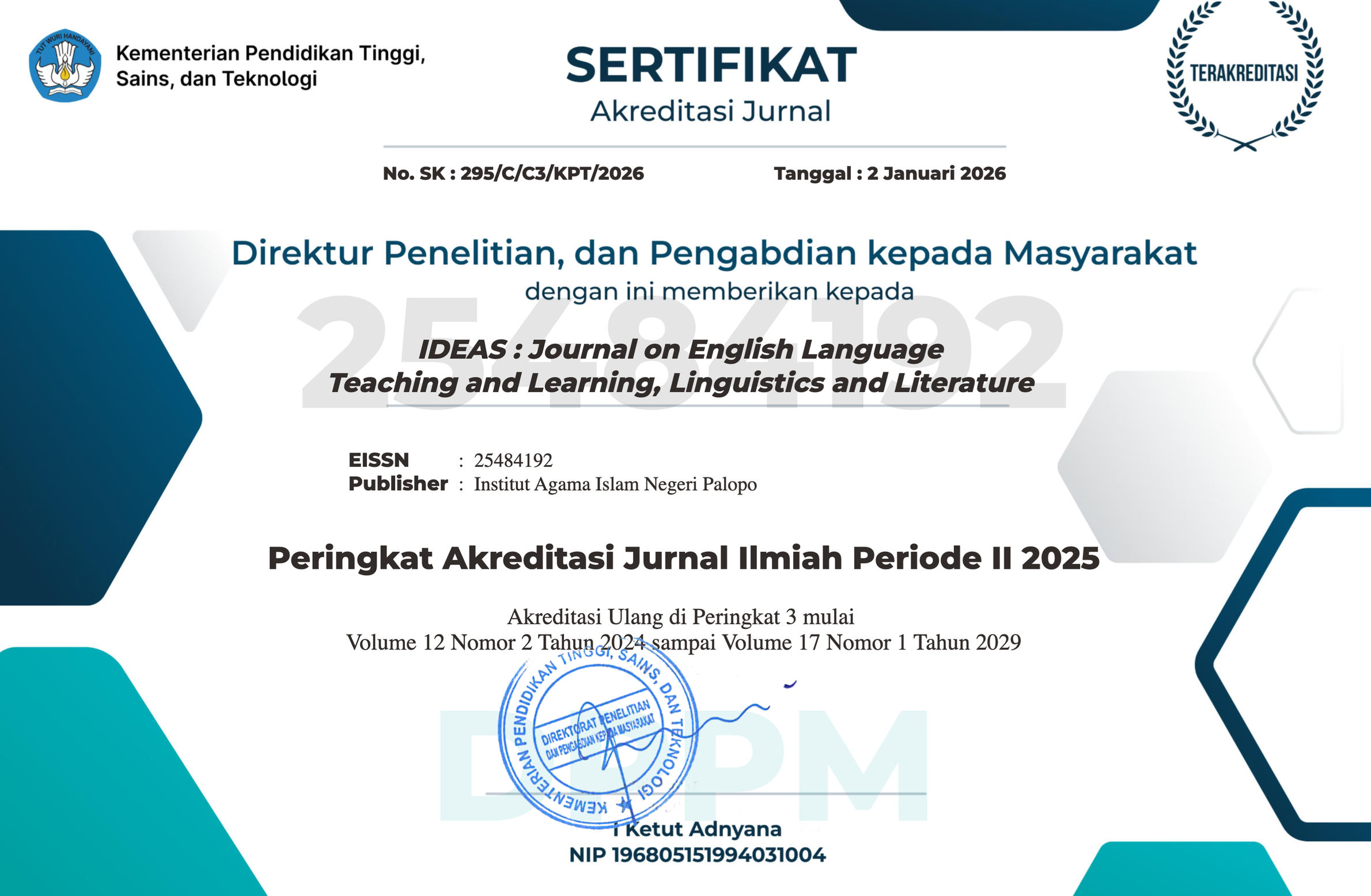
Uncovering Cultural Heritage Buildings in Luwu
DOI:
https://doi.org/10.24256/ideas.v14i2.7778Keywords:
Culture, Heritage BuildingAbstract
This study explores the architectural features and historical significance of selected cultural heritage buildings in Palopo City, South Sulawesi, Indonesia. Employing a descriptive qualitative approach, the research investigates nine heritage structures, including the Istana Datu Luwu, Masjid Jami Tua Palopo, and Gereja Pniel, to uncover their original functions, structural transformations, and cultural symbolism. Data were collected through field observations, interviews, and documentation, providing rich insights into the preservation status and evolving roles of these historical sites. The findings reveal that these buildings serve not only as physical remnants of Luwu's past but also as cultural texts that reflect the region’s identity, religious history, and colonial encounters. The study emphasizes the dual function of these sites in promoting local pride and serving as educational tools in English language learning. By integrating cultural heritage with English reading materials, the research contributes to both heritage preservation and language pedagogy, fostering intercultural awareness among younger generations. This approach underscores the importance of safeguarding tangible heritage while enhancing communicative competence through culturally embedded content.
References
Byram, M. (1997). Teaching and assessing intercultural communicative competence. Clevedon: Multilingual Matters.
Creswell, J. W. (2014). Research design: Qualitative, quantitative, and mixed methods approaches (4th ed.). Thousand Oaks, CA: Sage Publications.
Hermawan, B., & Noer, S. H. (2021). Developing local wisdom-based English materials for junior high school students. Journal of English Language Teaching and Linguistics, 6(1), 151–168. doi:10.21462/jeltl.v6i1.507
Kemendikbud. (2020). Kurikulum 2013 revisi: Buku guru Bahasa Inggris SMP/MTs kelas VIII. Jakarta: Kementerian Pendidikan dan Kebudayaan.
Kramsch, C. (1998). Language and culture. Oxford: Oxford University Press.
Kusuma, A. (2021). Preserving historical buildings in South Sulawesi: A study of cultural sustainability. Journal of Indonesian Heritage Studies, 5(2), 45–57.
Lincoln, Y. S., & Guba, E. G. (1985). Naturalistic inquiry. Beverly Hills, CA: Sage Publications.
Lowenthal, D. (1998). The heritage crusade and the spoils of history. Cambridge: Cambridge University Press.
Miles, M. B., & Huberman, A. M. (1994). Qualitative data analysis: An expanded sourcebook (2nd ed.). Thousand Oaks, CA: Sage Publications.
Moleong, L. J. (2016). Metodologi penelitian kualitatif (Edisi revisi). Bandung: PT Remaja Rosdakarya.
Patton, M. Q. (2002). Qualitative research and evaluation methods (3rd ed.). Thousand Oaks, CA: Sage Publications.
Wahyuni, S. (2020). Integrating local culture in ELT to improve students' intercultural competence. International Journal of Language Education, 4(3), 412–422. doi:10.26858/ijole.v4i3.14353
Wiryomartono, B. (2019). Architectural humanities: Towards a cultural sustainability in Southeast Asia. Singapore: Springer.
Downloads
Published
Issue
Section
Citation Check
License
Copyright (c) 2026 Amin Rais, Sahraini, magfirah Thayyib

This work is licensed under a Creative Commons Attribution-ShareAlike 4.0 International License.
Authors retain copyright and grant the journal right of first publication with the work simultaneously licensed under an Attribution-ShareAlike 4.0 International (CC BY-SA 4.0) that allows others to share the work with an acknowledgement of the work's authorship and initial publication in this journal.
Authors are able to enter into separate, additional contractual arrangements for the non-exclusive distribution of the journal's published version of the work (e.g., post it to an institutional repository or publish it in a book), with an acknowledgement of its initial publication in this journal.
Authors are permitted and encouraged to post their work online (e.g., in institutional repositories or on their website) prior to and during the submission process, as it can lead to productive exchanges, as well as earlier and greater citation of published work (See the Effect of Open Access)