TOOLS


INDEXING







CITATION ANALYSIS

ACCREDITATION
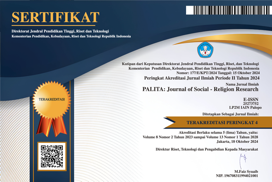

Palita: Journal of Social-Religion Research applies a double-blind peer review process to original research articles and scholarly review articles. Under this process, authors' identities are concealed from reviewers, and reviewers' identities are concealed from authors.
Each manuscript that proceeds to external peer review is evaluated by at least two independent reviewers with relevant subject and methodological expertise. The review process supports the assessment of scholarly quality, originality, research integrity, and relevance to the journal's focus and scope.
The journal follows the principles of the COPE Ethical Guidelines for Peer Reviewers. Editorial decisions remain the responsibility of human editors and are based on scholarly merit, available evidence, and compliance with publication ethics.
Before external peer review, the editorial team screens each submission to determine whether it meets the journal's basic requirements. The assessment considers:
The editors may reject manuscripts that fall outside the journal's scope or have fundamental scholarly or ethical shortcomings without external review. Manuscripts requiring technical corrections may be returned to the authors before further consideration.
Authors must follow the Author Guidelines and submit an anonymised review manuscript. Names, affiliations, acknowledgements, and other identifying information must be removed from the review version where appropriate or supplied separately. The editorial team checks the review files for identifying information.
Initial editorial screening is normally completed within four to six weeks after receipt of a complete submission. This period includes the initial editorial queue and may vary depending on submission volume and the complexity of the preliminary assessment.
The journal screens manuscripts for textual similarity before external peer review and may repeat the assessment after revision. An overall similarity index of 25% serves as an initial screening reference, not as an automatic determination of plagiarism.
Editors examine matched passages, their sources, attribution, quotation practices, and the nature and extent of any overlap. Properly attributed quotations, reference lists, and standard disciplinary expressions are considered when interpreting the similarity report.
A score above 25% requires closer editorial examination and may lead to a request for clarification or revision, or to rejection when substantial inappropriate overlap is established. Conversely, a score below 25% does not establish that a manuscript is free from plagiarism. Suspected plagiarism, redundant publication, and other integrity concerns are assessed on the available evidence, with an opportunity for the authors to respond where appropriate.
The handling editor appoints at least two independent reviewers for each manuscript that proceeds to external peer review. Reviewers are selected according to the following criteria:
Reviewers must disclose any personal, professional, financial, intellectual, or other competing interests before accepting an invitation or as soon as such interests become apparent. They must decline or withdraw from an assignment when a conflict prevents an impartial assessment.
If reviewers recognise or suspect an author's identity and believe that this could create a conflict, they must inform the editor. The editor will determine whether reassignment is necessary. Reviewers who decline an invitation or cannot complete an assignment will be replaced when required.
Reviewer selection and appointment are normally completed within four to six weeks after the initial editorial screening has been completed. This timeframe depends on reviewer availability, the relevance of potential reviewers' expertise, and the need for additional invitations or replacements.
Reviewers provide a written and substantive assessment using criteria appropriate to the article type. These criteria include:
Reviewers must explain the reasons for their recommendations, identify specific improvements, distinguish essential revisions from optional suggestions, and support substantive criticisms with clear reasoning. They may recommend acceptance, revisions, or rejection, but their recommendations inform rather than replace the editor's independent judgment.
Review reports are normally due within four to six weeks after the reviewer accepts the assignment and receives the review materials. Reviewers should notify the handling editor promptly if they need an extension or cannot complete the assessment.
Manuscripts, supplementary materials, reviewer reports, and editorial correspondence are confidential. Reviewers must not disclose these materials to unauthorised persons or use unpublished information for personal or professional advantage. Any involvement of another person in the review process requires prior editorial permission and appropriate confidentiality arrangements.
Reviewers must provide respectful and objective assessments and avoid discriminatory, personal, or irrelevant remarks. They must not request irrelevant citations to increase their own or another party's citation counts. Suspected research or publication misconduct must be reported confidentially to the editor.
Reviewers must not use AI applications to analyse, summarise, evaluate, or interpret confidential manuscripts, or to generate, rewrite, translate, or polish review comments. They must not enter or upload manuscripts, manuscript excerpts, supplementary materials, or confidential review information into AI applications.
Editors must not use AI to replace scholarly judgment or make editorial decisions on their behalf. Any permitted AI assistance by authors or editors must comply with the journal's AI Policy. Human authors, reviewers, and editors remain responsible for their respective contributions and decisions.
After considering at least two completed independent reviews, the Editor-in-Chief or an authorised editor without a relevant conflict of interest makes the editorial decision. The decision reflects the substance and quality of the reviews, the manuscript's scholarly merit, and compliance with publication standards. It is not determined solely by a majority vote among reviewers.
The possible editorial decisions are:
When reviewers' reports differ substantially or leave important issues unresolved, the editor may request clarification or obtain an additional independent review. Authors receive the editorial decision, its principal reasons, and anonymised reviewer comments. A request for revision does not guarantee acceptance.
Submissions by editors or editorial board members follow the same review standards as other manuscripts. The submitting editor or board member must be excluded from reviewer selection, access to confidential reviewer identities, and decision-making. An independent editor manages the submission.
The first editorial decision following external peer review is normally issued within four to six weeks after the reviewers receive the manuscript. This timeframe depends on the timely completion of review reports and any additional assessment required by the editor. Manuscripts rejected during initial screening may receive a decision earlier.
Authors should submit minor revisions within two weeks and major revisions within four weeks of the editorial decision. Authors who need additional time should request an extension from the handling editor before the deadline. Revised submissions must include:
Major revisions are normally returned to the original reviewers. If an original reviewer is unavailable or additional expertise is needed, the editor may appoint a qualified replacement. Minor revisions may be assessed by the handling editor or returned to reviewers when necessary.
Re-evaluation of a revised manuscript is normally completed within two weeks after the journal receives the complete revised submission and the accompanying point-by-point response. This period covers editorial checks, reviewer assessment where required, and the subsequent decision. Additional expert review or substantial unresolved issues may extend the timeframe.
The journal may request further rounds of revision when necessary. Authors must preserve anonymisation throughout the re-review process.
After acceptance, manuscripts proceed to copyediting, typesetting, and proof checking. Authors must review the proofs for accuracy and respond to editorial queries within the specified timeframe. Substantive changes at this stage require editorial approval and may require further review.
Production is normally completed within two weeks after final acceptance, provided that the manuscript is ready for production and all author requirements, including proof corrections, have been fulfilled. Substantive changes, delayed proof corrections, or unresolved production issues may extend this period.
Acceptance does not prevent the journal from investigating subsequently identified integrity concerns. When credible concerns arise before publication, the journal may pause production while assessing the evidence and determining the appropriate action.
Authors may appeal an editorial decision by contacting the editorial office through the journal's Contact page. Appeals must identify the manuscript and decision, explain specific grounds for reconsideration, and provide supporting evidence, such as a material factual error or a concern about the fairness of the editorial process.
An editor without a relevant conflict of interest assesses the appeal. The journal may seek an additional independent assessment when necessary. The editorial office communicates the outcome and its reasons to the authors. An appeal does not guarantee reversal of the original decision.
The journal maintains records of reviewer assignments, review reports, author responses, and editorial decisions within its editorial management system. Allegations of compromised peer review or other publication misconduct are handled with reference to relevant COPE guidance and the journal's publication ethics policies.
TOOLS
INDEXING
CITATION ANALYSIS
ACCREDITATION
