SUBMISSION
PUBLICATIONS
ACCREDITATION
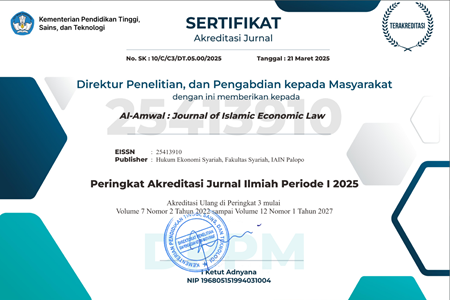
ASSOCIATION

SCOPUS CITATION ANLYTICS

TEMPLATE

SUPPORT CONTACT




Al-Amwal: Journal of Islamic Economic Law is a peer-reviewed open access journal published by the Faculty of Sharia, Universitas Islam Negeri Palopo. This statement outlines the ethical standards and responsibilities of all parties involved in the publication process, including authors, editors, reviewers, and the publisher. The journal is committed to upholding the principles of academic integrity and ethical publishing in accordance with the Committee on Publication Ethics (COPE) guidelines.
Authors submitting manuscripts to Al-Amwal are required to adhere to the following ethical responsibilities:
Originality and Plagiarism
Authors must ensure that their manuscripts are original works. Any use of others’ ideas, data, or words must be properly cited. All submissions will be screened using plagiarism detection software (Turnitin). Manuscripts with a similarity index exceeding the journal’s threshold will be rejected or returned for revision.
Multiple, Redundant, or Concurrent Publication
Authors should not submit the same manuscript simultaneously to more than one journal or publish substantially similar research in multiple venues.
Authorship of the Manuscript
Authorship should be limited to individuals who have made significant contributions to the conception, design, execution, or interpretation of the study. All contributors must be properly acknowledged.
Data Accuracy and Research Integrity
Authors are responsible for the accuracy of the data presented in their manuscripts. Fabrication, falsification, or manipulation of research data constitutes unethical behavior and is unacceptable.
Disclosure of Conflicts of Interest
Authors must disclose any financial, institutional, or personal relationships that could influence the research results or interpretation.
Editors of Al-Amwal are responsible for ensuring the integrity and quality of the publication process. Their responsibilities include:
Editorial Decision-Making
Editors evaluate manuscripts solely on academic merit, originality, relevance to the journal’s focus and scope, and contribution to the field, without discrimination based on authors’ race, gender, institutional affiliation, or political beliefs.
Confidentiality
Editors must ensure the confidentiality of submitted manuscripts and not disclose any information about a manuscript under review to unauthorized parties.
Conflict of Interest
Editors must recuse themselves from handling manuscripts in which they have conflicts of interest.
Handling of Ethical Issues
Editors will take appropriate action when ethical complaints arise, including plagiarism, data fabrication, or authorship disputes, in accordance with COPE procedures.
Peer reviewers play a critical role in maintaining the scholarly quality of the journal. Reviewers are expected to:
Contribution to Editorial Decisions
Reviews should be conducted objectively, clearly, and constructively to assist editors in making informed decisions and to help authors improve their manuscripts.
Confidentiality
Manuscripts received for review must be treated as confidential documents and must not be shared or discussed with others without authorization from the editor.
Objectivity and Fairness
Reviewers should evaluate manuscripts based on academic merit and avoid personal criticism of the authors.
Disclosure of Conflicts of Interest
Reviewers must inform the editor if they have any conflicts of interest that could affect their impartiality and should decline the review if necessary.
The publisher, Faculty of Sharia, Universitas Islam Negeri Palopo, is committed to ensuring that editorial decisions are independent and not influenced by commercial interests. The publisher supports the journal in maintaining ethical standards, editorial freedom, and long-term digital archiving through recognized preservation systems.
Al-Amwal takes allegations of publication misconduct seriously. Any reported cases of plagiarism, data fabrication, citation manipulation, or other unethical practices will be investigated thoroughly. Actions may include manuscript rejection, retraction of published articles, and notification to relevant institutions, in line with COPE guidelines.
All articles published in Al-Amwal are freely accessible under an open access policy. The journal applies the Creative Commons Attribution-ShareAlike (CC BY-SA) license, allowing others to share and adapt the work with proper attribution.
SUBMISSION
PUBLICATIONS
ACCREDITATION
ASSOCIATION
SCOPUS CITATION ANLYTICS
TEMPLATE
SUPPORT CONTACT
TOOLS


USER
MEMBERS

SPONSORED BY



Al-Amwal : Journal Of Islamic Economic Law, Faculty of Sharia, IAIN Palopo, Indonesia