About the Journal

Al-Amwal: Journal of Islamic Economic LawE-ISSN: 2541-3910 , P-ISSN: 2541-010 has been published twice a year since 2016, is a Bilingual (English and Indonesian), exploring the Law in Society on the research of Islamic Economic Law.

Al-Amwal: Jurnal of Islamic Economic Law is a double-blind peer-reviewed journal published by the Islamic Economic Law Study Program, Faculty of Sharia, IAIN Palopo, Indonesia.

The journal publishes research, conceptual, and book reviews of Islamic Economic Law (See Focus and Scope). Authors should ensure the submitted manuscript has been prepared using the Al-Amwal Template. Manuscripts must also have been proofread with a similarity check using Turnitin. Reference writing must use citation manager tools such as Mendeley, Zetero . Any manuscript that does not meet the author's guidelines, focus, and scope, is written in a different format, and does not meet the administrative requirements will be rejected immediately. The only manuscripts that meet Al-Amwal's standards will be processed further.

JOURNAL'S INFORMATION

Name

: Al-Amwal: Journal of Islamic Economic Law

Initial

: Al-Amwal

Frequency

: Biannual (March & September)

E-ISSN

: 2541-3910

P-ISSN

: 2541-0105

COPYRIGHT

: CC-BY-SA

Editor in Chief

: Muhammad Fachrurrazy

Publisher

: Sharia Faculty, State Islamic University of Palopo, Indonesia

Accreditation

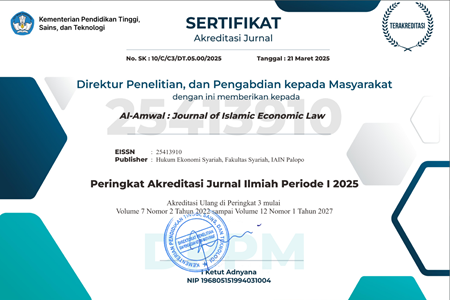
: SINTA 3 [System for Ranking Indonesian Scientific Journals]

Announcements

Current Issue

Vol. 11 No. 2 (2026): Al-Amwal : Journal of Islamic Economic Law
					View Vol. 11 No. 2 (2026): Al-Amwal : Journal of Islamic Economic Law

From Fiqh to Governance: Legal Transformation in Islamic Economic Governance

This issue explores the transformation of Islamic Economic Law from a normative orientation toward governance-based approaches that address contemporary socio-economic challenges. It welcomes scholarly contributions examining the role of Islamic legal principles in shaping accountable institutions, public policy, and sustainable economic governance. Topics include Islamic financial governance, halal governance, zakat and waqf governance, digital economy, fintech regulation, Islamic social finance, public accountability, and maqāṣid al-sharī‘ah as a framework for legal and institutional reform. By integrating classical Islamic jurisprudence with contemporary governance perspectives, this issue aims to advance innovative research that contributes to justice, transparency, public trust, and sustainable socio-economic development.

Authors Coverage :  Indonesia ,  Egypt

Published: 2026-07-31

Articles

View All Issues